Pranic Lifestyle
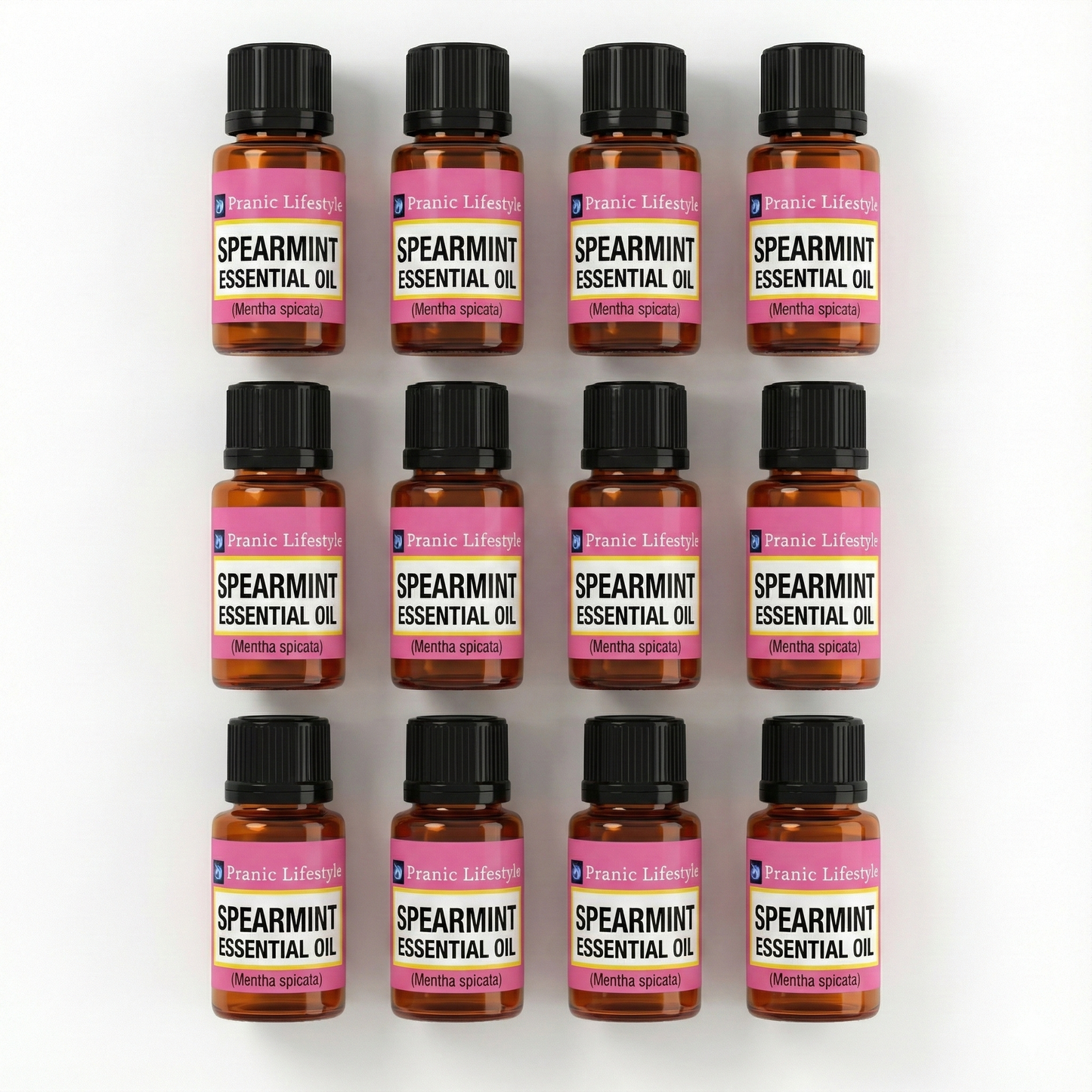
Spearmint Essential Oil (Mentha spicata) | Pranic Energy Jewelry
Couldn't load pickup availability
Mentha spicata — Spearmint | Steam-distilled | Origin: USA / India (Uttar Pradesh)
Key constituent: R-(−)-Carvone 55–75% | Top note | GC/MS tested
Pranic color: Green and blue-green prana | Chakras: Throat · Solar Plexus · Ajna
Spearmint and Peppermint share a genus but not a philosophy. Where Peppermint delivers a thermally aggressive menthol shock — TRPM8 receptor activation, instant sinus-clearing force — Spearmint operates on a different principle entirely: flow. Its dominant molecule, R-(−)-Carvone, carries none of peppermint's cooling menthol. What it carries instead is a sweeter, rounder, more liquid clarity — an aroma that gentles the nervous system rather than startling it, and opens the channels of communication rather than blasting them clear.
In Pranic healing this distinction matters. Peppermint is a purifier-by-force. Spearmint is a purifier-by-flow — an instrument of the Throat chakra, the Solar Plexus, and the quality of expression that emerges when both are in harmonious alignment.
The Chirality Lesson: Why Carvone Defines This Oil
Carvone is a chiral molecule — it exists in two mirror-image forms that share an identical chemical formula but interact with human sensory receptors completely differently. R-(−)-Carvone (spearmint's form, 55–75% of this oil) produces the characteristic sweet, cool, herbal-minty aroma that registers as gentle and approachable. S-(+)-Carvone — the mirror image — smells like caraway and dill seed. The entire sensory difference between a breath-mint and a rye cracker is a single mirror flip of one molecule.
This is not a minor detail. It explains why spearmint, despite being in the same genus as peppermint and carrying a similar "minty" reputation, presents an entirely different aromatic and energetic experience: less thermal, less aggressive, more suited to sustained diffusion and therapeutic blending where peppermint would overpower.
The remaining 25–45% of the oil includes limonene (5–15%, citrus brightness), dihydrocarvone (3–8%, deepens the minty warmth), β-myrcene (1–5%), and trace linalool, menthol (less than 1%), and caryophyllene. This is why spearmint's aromatic profile is more complex and longer-lasting than a single-constituent oil — the supporting cast adds body and longevity to carvone's lead note.
Botanical Specification
| Parameter | Specification |
|---|---|
| Botanical name | Mentha spicata L. (Spearmint) |
| Family | Lamiaceae (mint family) |
| Origin | USA (Pacific Northwest) / Uttar Pradesh, India |
| Extraction | Steam distillation of aerial parts (leaves and flowering tops) |
| Aroma profile | Sweet, herbal-mint, cool, slightly fruity-green, more rounded than peppermint |
| Note | Top note, moderate longevity |
| Key constituents | R-(−)-carvone (55–75%), limonene (5–15%), dihydrocarvone (3–8%), β-myrcene (1–5%) |
| Menthol content | <1% — the key difference from peppermint (40–55% menthol) |
| Pranic color | Green and blue-green prana (cleansing, cooling, communication) |
| Primary chakras | Throat (Vishuddha), Solar Plexus (Manipura), Ajna (Third Eye — diffused) |
Pranic Energetic Profile: The Architect of Clarity
In Pranic healing, green prana cleanses and dissolves congestion — it sweeps energetic debris from the field and from chakras where stagnation has accumulated. Blue prana cools and calms — it settles overactivated centers, soothes inflammation in the energetic anatomy, and supports the communication centers of the Throat. Spearmint, with its carvone-dominant, non-menthol profile, delivers both qualities without the thermal intensity that makes peppermint unsuitable for sustained or sensitive applications.
The Throat chakra governs authentic expression — the capacity to say what is true, diplomatically and with precision. When the Throat is congested (from suppressed words, fear of conflict, or chronic over-talking that drowns the signal), communication becomes either too hot (reactive) or too cold (withdrawn). Spearmint's blue-green vibration threads the middle path: it cools heated expression while simultaneously dissolving the energetic "lump" of unexpressed truth.
Ritual Applications
✦ Throat Chakra Communication Diffuser
3 drops spearmint · 2 drops blue chamomile · 2 drops bergamot
Diffuse 20 minutes before difficult conversations, presentations, or any communication requiring calm precision. Carvone + bergamot's linalool combination provides alertness without agitation.
✦ Spearmint vs Peppermint: When to Choose Which
Choose Spearmint when: children present (safer at 1% dilution), sustained focus work, Throat/communication support, sensitive individuals, gentle morning diffusion.
Choose Peppermint when: maximum cooling needed, sinus/congestion clearing, high-intensity wake-up, short-burst energy activation.
The oils are not interchangeable — they are complementary tools with different intensities and chakra targets.
✦ Solar Plexus Clarifying Blend (2% dilution)
4 drops spearmint · 3 drops grapefruit · 2 drops rosemary · 1 oz jojoba
Apply to upper abdomen in clockwise direction before decision-making or creative work. The carvone-limonene combination supports mental clarity without thermal activation.
▶ FAQ — Spearmint Essential Oil
Why does spearmint smell so different from peppermint if they're in the same genus?
The aroma difference comes down to one molecule: menthol. Peppermint is 40–55% menthol, which activates cold-sensing TRPM8 receptors and creates the intense cooling thermal effect. Spearmint contains less than 1% menthol and is dominated instead by carvone — a sweeter, more rounded molecule that doesn't activate TRPM8. Same family, completely different sensory experience.
Is spearmint safe for children?
Spearmint is generally considered one of the safer mint oils for children (above age 6) when properly diluted — typically 0.5–1% maximum in a carrier oil. The key reason is the absence of menthol, which can cause breathing difficulties in young children. Always check with a certified aromatherapist or pediatrician before using essential oils with children. Never apply near the face of children under 10.
What is the Throat chakra connection?
In Pranic healing (and in various yogic systems), the Throat chakra (Vishuddha) governs authentic expression, communication, and the ability to speak one's truth. Oils with green-blue prana qualities are traditionally used to support this center — not by "opening" it in a mechanical sense, but by creating an aromatic environment conducive to the qualities associated with healthy throat function: clarity, calm, and honest communication.
Can I use spearmint in cooking the same way I'd use the herb?
Spearmint essential oil is highly concentrated — one drop is equivalent to approximately 1–2 tablespoons of fresh spearmint herb. Food-grade spearmint essential oil can be used in cooking at micro-doses (typically 1 drop per recipe serving). The oil in this store is therapeutic-grade and not marketed for culinary use. If using in cooking, ensure the bottle is labeled food-safe and use extreme dilution.
Safety: Avoid use with children under 6. Do not apply neat — dilute to 2% maximum for topical use (1% for sensitive areas). Avoid contact with eyes and mucous membranes. May cause mild skin sensitization in some individuals — perform patch test 24 hours before broader application. Generally considered safe during pregnancy in aromatherapy doses, but consult a healthcare provider. Toxic to cats and dogs — do not apply near pets.
These statements have not been evaluated by the Food and Drug Administration. This product is not intended to diagnose, treat, cure, or prevent any disease. All energetic and aromatic protocols are for spiritual and educational purposes only. For external and aromatic use only. Perform a patch test before topical application.
Share