Pranic Lifestyle
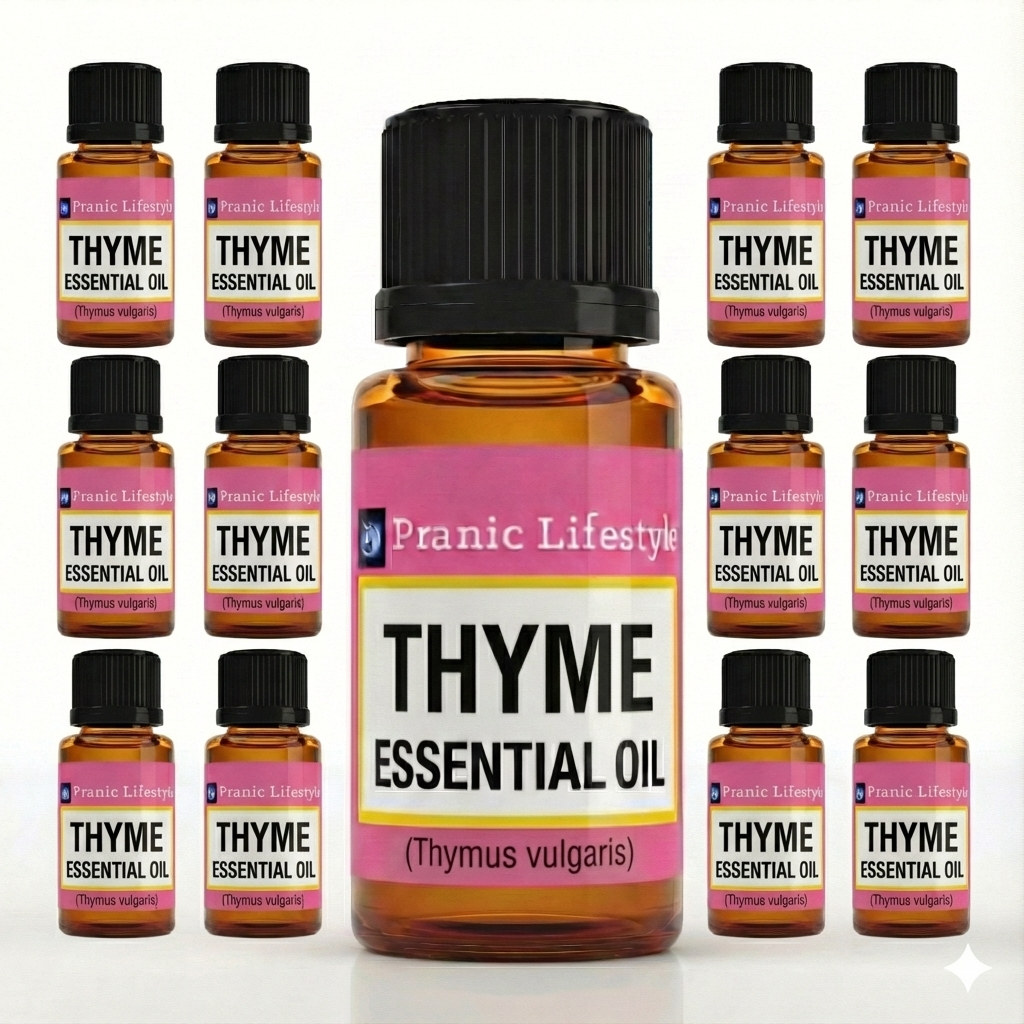
Thyme Essential Oil (Thymus vulgaris)
Couldn't load pickup availability
Thymus vulgaris ct. Thymol — Red Thyme | Steam-distilled | Origin: Spain
Key constituent: Thymol 30–50% + p-cymene 15–28% | Middle note | GC/MS tested
Pranic color: Red-orange prana | Chakras: Root · Solar Plexus | Dilute heavily — hot oil
Not all Thyme is created equal, and this is not a polite botanical qualifier — it is a safety statement and a therapeutic map. Thymus vulgaris grows across a range of altitudes and climatic conditions in southern Europe, and this environmental pressure produces chemically distinct varieties (chemotypes) that share a common species name but diverge dramatically in composition and intensity. The most potent of these is the Thymol chemotype — "Red Thyme," distilled from the low-altitude, full-sun plants of the Spanish coast — and it is the one in this bottle.
Thymol, the dominant phenolic compound, is the molecule that gives conventional antiseptics their characteristic sharp, medicinal bite. In the oil, it constitutes 30–50% of the total composition — a concentration that demands respect. Red Thyme is not subtle. It is the most intense of the thyme chemotypes and the most useful, in traditional practice, for situations requiring force: deep energetic purification, fortification of a depleted will, and aromatic protection of space.
The Chemotype Distinction: Know What You're Using
There are four primary thyme chemotypes in commercial aromatherapy use. They are not interchangeable:
Thymus vulgaris ct. Thymol (this oil — "Red Thyme"): Thymol 30–50%, p-cymene 15–28%, γ-terpinene 5–15%, carvacrol 2–10%. The most intense and antimicrobially active chemotype. Powerful purifier; demands dilution (0.5–1% topical maximum). Not for children, elderly, or sensitive individuals.
Thymus vulgaris ct. Linalool: Linalool 60–80%, no thymol. The gentlest chemotype — suitable for children and elderly, diffusion-safe, much milder aroma. Completely different therapeutic profile.
Thymus vulgaris ct. Thujanol: Thujanol 40–55%. Liver-supportive, immune-modulating, considered the safest for long-term use.
Thymus vulgaris ct. Carvacrol: Carvacrol dominant (also found in high concentrations in oregano). Similar intensity to thymol type.
The Greek word thymos — the root of both Thymus and the ancient concept of vital spirit, courage, and heart-force — tells you what this plant has always represented. Mediterranean cultures burnt thyme as incense before battle. Roman soldiers bathed in thyme water for courage. Medieval European herbalists considered it the herb of "fiery resolution and active virtue." The chemistry confirms the tradition.
Botanical Specification
| Parameter | Specification |
|---|---|
| Botanical name | Thymus vulgaris L. ct. Thymol (Red Thyme) |
| Family | Lamiaceae |
| Origin | Spain (Catalonia / Mediterranean coastal belt) |
| Extraction | Steam distillation of dried flowering herb |
| Aroma profile | Sharp, hot, medicinal-herbal, penetrating, slightly sweet-earthy base |
| Note | Middle note with persistent top-note intensity |
| Key constituents | Thymol (30–50%), p-cymene (15–28%), γ-terpinene (5–15%), carvacrol (2–10%), linalool (1–5%) |
| Phenol content | High — thymol is a phenolic compound; requires heavy dilution, can irritate skin and mucous membranes |
| Pranic color | Red-orange prana (intensely energizing, purifying, fortifying) |
| Primary chakras | Root (Muladhara), Solar Plexus (Manipura) |
Pranic Energetic Profile: The Warrior's Shield
In Pranic healing, red prana is the most energizing of all prana colors — it vitalizes, fortifies, and generates heat in depleted energetic fields. Orange prana dissolves and expels congested or diseased energy. Together they form the combination used for "intense sweeping" and deep-field purification. Red Thyme, with its thymol-dominant, high-phenol profile, is the sharpest red-orange prana carrier among the common essential oils — its energetic "temperature" is high by design.
The Root chakra, governing physical vitality, survival instinct, and earthly security, is the natural home of red prana work. When the Root is depleted — from prolonged illness, adrenal exhaustion, or sustained fear — the entire energetic system above it loses its foundation. Red Thyme, used at safe dilutions in diffusion or topical application, is traditionally employed to fortify this base before any higher-chakra work begins.
Ritual Applications
✦ Space Purification Diffuser (use sparingly)
1 drop Red Thyme · 3 drops frankincense · 2 drops orange
One drop of thymol-type thyme is sufficient for a full room — more is not better with this oil. Diffuse maximum 20 minutes in a ventilated space. Frankincense and orange soften the intensity while preserving the purifying character.
✦ Root Fortification Blend (0.5% dilution)
1 drop Red Thyme · 2 drops vetiver · 2 drops cedarwood · 1 oz jojoba
Apply to soles of feet only (thick skin, safer for phenolic oils). Vetiver and cedarwood ground the intensity of thymol's red-orange activation into stable, earthy foundation energy. Perform before physically demanding days or during periods of adrenal depletion.
▶ FAQ — Red Thyme Essential Oil
Why does the label say "Red Thyme" when thyme is a green herb?
The color refers to the color of the steam-distilled oil, not the plant. The high phenol content (thymol) gives the undistilled oil and its distillate a reddish-amber hue. The "White Thyme" sometimes sold commercially is a redistilled (rectified) version of Red Thyme where the thymol fraction has been reduced — gentler but less potent for purification applications.
How is this different from oregano essential oil?
Both Red Thyme (ct. Thymol) and Oregano (Origanum vulgare) are high-phenol oils from the Lamiaceae family — both contain thymol and carvacrol. The difference is proportion: oregano is typically 60–80% carvacrol (even more intense), while Red Thyme leads with thymol and a significant p-cymene fraction. Same category of intensity, slightly different aroma character. Both require the same dilution caution.
Is Red Thyme safe to diffuse around children or pets?
No. Thymol-type Thyme is contraindicated in diffusion around young children (under 12), infants, and pets (especially cats and small animals). Use the ct. Linalool chemotype for child-safe applications. For pets, consult a veterinarian before any essential oil diffusion.
What does "hot oil" mean in practice?
A "hot oil" is an essential oil containing high percentages of phenols (thymol, carvacrol, eugenol) or aldehydes that can cause burning, redness, and sensitization on direct skin contact. With Red Thyme, even a 1% dilution may feel warm on thin-skinned areas. Maximum recommended topical dilution is 0.5–1%, applied only to thicker-skinned areas (soles of feet, palms). Never apply near eyes, mucous membranes, or on broken skin.
Safety — read before use: High phenol content — a "hot oil." Maximum 0.5–1% dilution for topical use; apply to thick-skinned areas only (feet, palms). Never use neat. Contraindicated in: children under 12, pregnancy, nursing, elderly with sensitive skin. Avoid diffusing in enclosed spaces or near children and pets. Avoid if sensitive to phenolic compounds. May interact with blood-thinning medications. Always store away from heat and flame.
These statements have not been evaluated by the Food and Drug Administration. This product is not intended to diagnose, treat, cure, or prevent any disease. All energetic and aromatic protocols are for spiritual and educational purposes only. For external and aromatic use only. Perform a patch test before topical application.
Share